Why There's No Emergency at Machu Picchu Citadel August 19, 2026
Let's be clear about the headlines announcing an emergency in Machu Picchu.
The "emergency" you see in news reports is regarding a small town on the outskirts of Machu Picchu district, not the Machu Picchu ruins. Yes there are El Nino rains, which are heaviest in southern Peru, and Chile. They're heavy enough that the one and only road from the desert town of Ica to Arequipa is closed. One of the weakest links in a road system are the bridges. Not all bridges are constructed to the standards of western countries. Bridges may be closed during heavy seasonal rains for public safety. I've seen it happen in other places in Peru. (and Bolivia)
Do not confuse Machu Picchu district with Machu Picchu Citadel.
Machu Picchu citadel is fully operational and was not affected by the rainfall that took out footbridges on the Inca Trail. The only reason we're hearing about this situation is because it affects the ability of hikers on the 4-day Inca Trail to complete their trek to Machu Picchu. And it's a slow news day. Somewhere. Some reporters will see the words "Machu Picchu" and assume it's the actual citadel. Which it is not. The Machu Picchu district is a huge region and this small flood is not near Machu Picchu citadel. Vidal, my native business partner in Cusco claims that these kinds of weather-related events occur every year.
What happened?
The 4-day Inca Trail was closed on August 19, due to the landslide in the small village of Huayllabamba. A house collapsed into the Huayruro River and the footbridge was washed out. There was no way to continue on the famous path. Huayllabamba is a small village in the district of Machu Picchu, (estimated 40 km from the Machu Picchu citadel) It's also part of the official 4-day Inca Trail hike, which is why you'll see this story flash around the world. Our manager in Cusco, Vidal, reported that the cause of the washout was due to a naturally occurring dam of tree debris and mud that built up in a single spot upstream. Eventually, the slurry broke loose and tumbled downstream and smacked into the house and the footbridge. So debris from the surrounding woods had been piling up creating a dam, and nobody noticed it. As the rains continued, the stream swelled and that little dam burst. It wasn't due to super heavy rains. No one was hurt or injured. Authorities are arranging assistance for local families who need it. But this footbridge was an essential part of the trail for hikers. Without the footbridge, they can't continue their hike. Only the 4-day Inca Trail Hike was closed. This means hikers were not able to continue their hike because they had no access to the original trail network including the campgrounds.
When is the 4-Day Inca Trail reopening?
The latest re-opening date is September 5, 2026. The first official announcement stated the reopening would be on Wed, August 26, 2026. Since August 19 when the long Inca Trail hike shut down, the officials opened up the shorter Inca Trail routes on Km 104 and 106. And operators have also been taking their hiking groups to Salkantay. Access to the alternative trails are determined by variables like the number of hikers who are already booked. On August 25 they announced that they are not ready to open the 4-day Inca Trail yet. So. The estimated opening was September 1. But this is how they work. In these situations, no matter how much they want to open, the kind of work that is needed to make it accessible for foreigners is sometimes difficult to calculate. Organizing materials, labor and transport to the middle of nowhere cannot be done instantly. So. There's no guarantee amigos.
Is this normal weather in Machu Picchu?
Machu Picchu is in a cloud forest. Rainfall is one of the natural characteristics of mountainous terrain in a cloud forest. Having sudden rains in a cloud forest is quite normal, even during what is called the "dry season." Welcome to life in the Andes Mts folks!
The dry season refers to the Andes Mts as a region. Inside the mountainous regions there are micro-climates that experience their own fluctuations in moisture, cloud cover and weather conditions that are subject to change year round.
Does the closure of the 4-day Inca Trail affect travelers going to Machu Picchu by train?
No. If you recall, on August 4, train service to Machu Picchu was suspended due to a wildfire near the tracks. Read more about that here. Service was restored on August 5. Train travelers were affected by the suspension. But rain is fairly common in the cloud forest eco-system. Unless the rain causes a mudslide, it's all systems go. Currently, train service to Aguas Calientes, the gateway town to Machu Picchu is fully operational. The closure of the footbridge in Huayllabamba affects only the hikers on the 4-day trail. That comes to about 200 hikers per day. At this time, the 1-day Inca Trail hike is still open. How often is train service to Machu Picchu disrupted? We looked into that. Read more here.
Can Inca Trail hikers get refunds due to closure of the trek on August 19, 2026
This is a complicated situation. And the answer is "no." The cost of the actual hiking permit provided by the government is a small part of the total cost of the hike. Tour Operators also pay wages and porter taxes, buy food, fuel, train tickets, and shuttle bus tickets. As you can see there is a stack of expenses to unravel. Should porters lose their wages? Can perishable food be returned to the markets?
What happened to the Inca Trail Hikers? Did they go to Machu Picchu?
Hikers were sent back to Ollantaytambo, since passing through Huayllabamba is on day 1. Many hikers were hoping to use the path for the 1-day Inca Trail hike to allow them to enter Machu Picchu through the sungate. But in the beginning, this request was refused due to capacity limitations. Eventually they did open up and allow last-minute permits for km 104 and 106. But operators had to apply for these permits.
Hikers were allowed to take the train from Ollantaytambo to the village of Aguas Calientes, at their expense, and go up to Machu Picchu to circuit 1 for the panoramic view on one day, and then back to Machu Picchu the next day to tour circuit 3 according to the dates of their permits. Hikers will need to be prepared to buy 1-way train tickets to Aguas Calientes, bus tickets to Machu Picchu and possibly 1 night hotel in the village of Aguas Calientes.
It's up to the tour operator to determine how much assistance they want to offer their hiking clients. Will they help these hikers book extra trains, bus tickets and hotels? The Peru government is not responsible for these extra expenses. It's on hikers to accept all risk for choosing a good tour operator and covering unexpected expenses if something happens on their hike. Like I said folks, "Welcome to Peru!"
Is there excessive rain at Machu Picchu this year?
No. It's within the normal range for areas in the cloud forest and the desert to experience occasional heavy outbursts, even during an El Nino "dry season." I've seen the steep narrow cobblestone streets and stairways of Cusco turn into sudden gushing waterfalls. It's because there's no drainage system in the upper neighborhoods or trash clogs the drains that are there, and water runs down steep hills very fast. It's temporary and the streets get cleaned and it doesn't seem to last long.
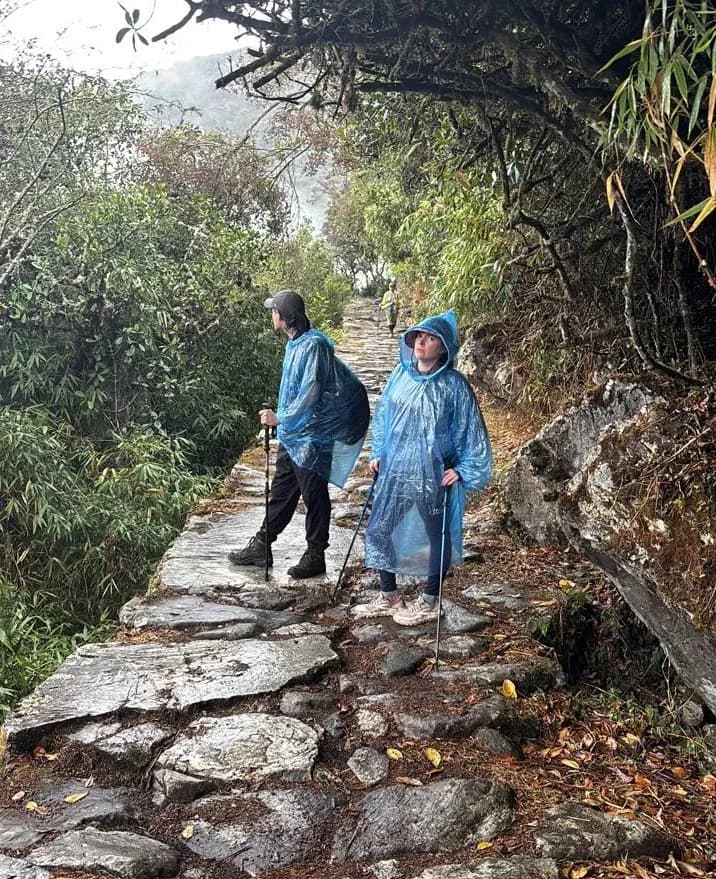
The image featured with this post is from the 1 Day Inca Trail on August, 10, 2026. Are you curious about the 1-day Inca Trail hike? It's a fantastic mini-adventure that's doable by most active travelers who are short on time or just don't want to camp on their vacation. Here's a link to see the details of the hike.

And then to top it off, there was an Earthquake in Peru on August 20.
The 7.2 earthquake was felt in the city of Cusco, but was most noticed in the region of Ayacucho and areas south, down into Chile and Argentina. There was no damage in Peru except for the road closures south of Ica. Tourists in the region of Lake Humantay (120 km from Cusco) captured video of a falling ice mass above the lake. If you're been to Cusco, you may have noticed the huge megalithic stone buildings sitting on a foundation of smaller stones. This is a technique used by the Inca to protect the buildings from collapse during earthquakes. Which begs the question. How common must it be for earthquakes to occur?
So. floods, wildfires, heavy rains and earthquakes. And still, 1.5 to 1.6 million visitors make it to the middle of nowhere to see Machu Picchu every year. It's amazing isn't it. In case you're still here, and you want to read the story of a mudslide that my group and I missed by 10 or 15 minutes, while hiking in to Aguas Calientes from the back side, go here.
Planning a trip for 6 or more?
We design private trips for families with kids, friend groups, clubs, and special-interest groups. Groups of 6+ are our specialty.